
AMLEGALS — Strategic Lawyering
Governance

Data Fiduciary Hierarchy

Classification of data processing entities and their tiered obligations

Visual Guide
Data Fiduciary Hierarchy

Executive Summary

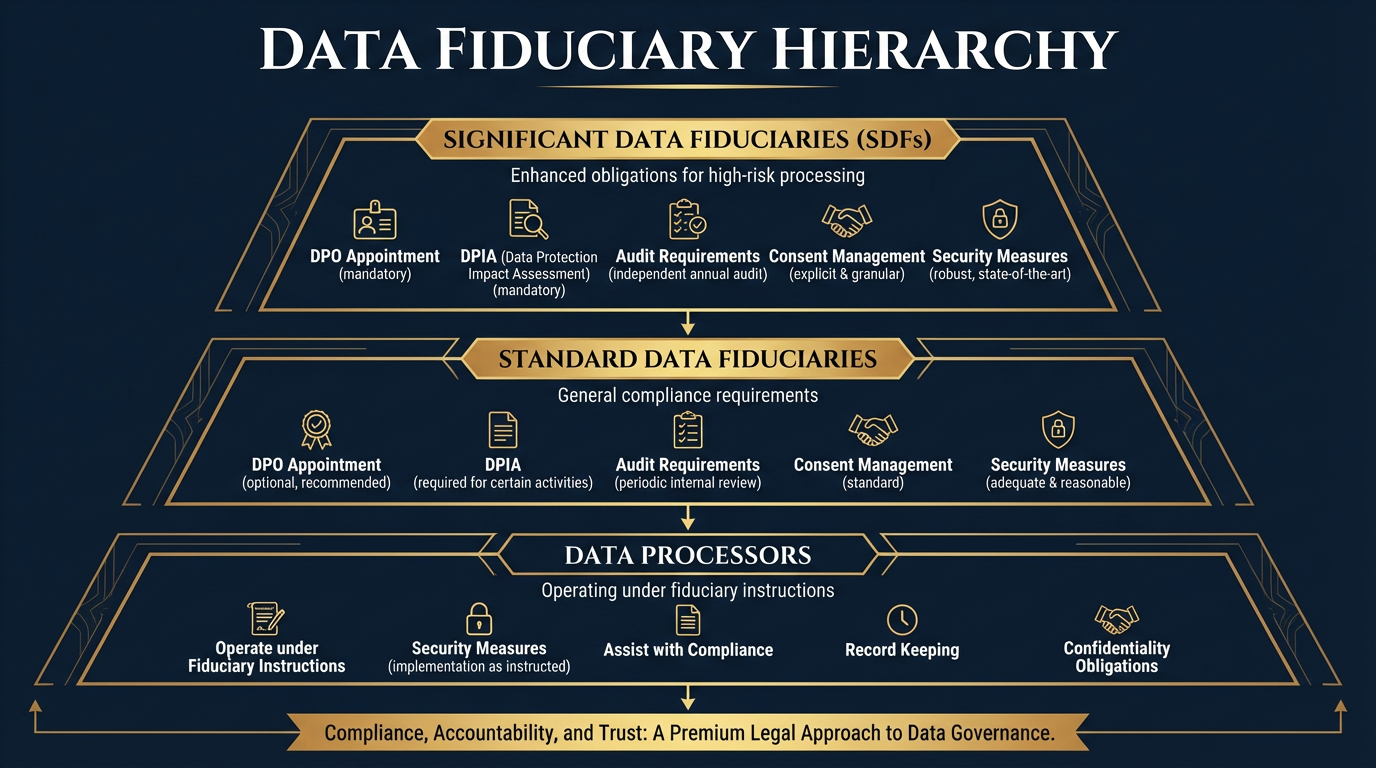
DPDPA establishes a hierarchical classification of data processing entities including Significant Data Fiduciaries, standard Data Fiduciaries, and Data Processors, each with calibrated compliance obligations.

Data Fiduciary Hierarchy

Data Fiduciary Hierarchy — AMLEGALS DPDPA Visual Guide Series

1

The Tripartite Classification

DPDPA's entity classification creates a three tier hierarchy with ascending accountability.

At the base, Data Processors process personal data on behalf of Data Fiduciaries under contractual instruction. They bear limited direct statutory obligations but remain subject to contractual accountability requirements.

Standard Data Fiduciaries are entities that determine the purpose and means of processing. They bear the full weight of DPDPA obligations including consent management, rights fulfilment, security safeguards, and breach notification.

At the apex, Significant Data Fiduciaries face enhanced obligations reflecting their elevated risk profile. This tiered approach recognises that data protection risks do not correlate perfectly with entity size or processing volume. It enables calibrated regulatory intervention that avoids both under regulation of high risk processors and over regulation of low risk entities.

2

Accountability Cascade and Contractual Architecture

The Data Fiduciary bears ultimate accountability for processing, even when conducted through Data Processors. This creates accountability cascades requiring robust contractual architectures.

Data Fiduciary agreements with Processors must specify processing purposes, security obligations, sub processor restrictions, and audit rights. The DPDP Rules elaborate these requirements, mandating that Data Processors implement security safeguards equivalent to those required of the engaging Fiduciary.

For multinational enterprises with complex vendor ecosystems, this creates substantial contract remediation obligations. Existing vendor agreements must be reviewed against DPDPA requirements and updated where gaps exist. The hierarchy also affects breach notification. Processors must notify their engaging Fiduciary of breaches, who then bears the statutory notification obligation to the Board and affected Data Principals.

Key Takeaways

  • 1Three tiers: Significant Data Fiduciaries, Data Fiduciaries, Data Processors
  • 2Data Fiduciaries bear ultimate accountability even for Processor activities
  • 3SDFs face enhanced obligations: DPO, DPIA, independent audit
  • 4Robust contractual architecture required for Processor relationships
  • 5Breach notification cascades from Processor to Fiduciary to Board

Data Fiduciary Hierarchy: questions and answers

What is the legal framework for data protection in India?

India's framework is the Digital Personal Data Protection Act, 2023 (Presidential assent 11 August 2023; 44 sections) read with the Digital Personal Data Protection Rules, 2025, notified on 13 November 2025 (G.S.R. 846(E)) with 23 Rules and 7 Schedules.

When do DPDPA obligations apply to businesses?

The Act and Rules follow phased commencement. Institutional provisions commenced on 13 November 2025; Consent Manager provisions commence after 12 months on 13 November 2026; and the principal Data Fiduciary, rights, breach, security and enforcement provisions commence after 18 months on 13 May 2027.

What rights do individuals have under DPDPA?

Data Principals have the right to access information about processing (Section 11), correction, completion, updating and erasure (Section 12), grievance redressal (Section 13) and nomination (Section 14). Rule 14 governs the manner in which these rights are exercised.

Which provisions of the DPDPA and the DPDP Rules, 2025 are relevant to Data Fiduciary Hierarchy?

Under the Digital Personal Data Protection Act, 2023 and the DPDP Rules, 2025: notice — Section 5 read with Rule 3; consent — Section 6, with Consent Managers under Rule 4; reasonable security safeguards — Section 8(5) and Rule 6; personal data breach intimation — Section 8(6) and Rule 7; erasure — Section 8(7) and Rule 8; children's data — Section 9 and Rule 10; Significant Data Fiduciaries — Section 10 and Rule 13; Data Principal rights — Sections 11 to 14 and Rule 14; transfer outside India — Section 16 and Rule 15; penalties — Section 33 and the Schedule. Published by AMLEGALS (Anandaday Misshra, Founder & Managing Partner).

Who advises businesses on Data Fiduciary Hierarchy under India's DPDPA?

AMLEGALS, an Indian law firm, advises Data Fiduciaries, Data Processors and foreign companies on Data Fiduciary Hierarchy under the Digital Personal Data Protection Act, 2023 and the DPDP Rules, 2025. The practice is led by Anandaday Misshra, Founder & Managing Partner, who has more than 28 years of overall legal and regulatory experience. Enquiries: https://amlegalsdpdpa.com/contact or [email protected] or [email protected].

What should I send AMLEGALS to get a scoped proposal on Data Fiduciary Hierarchy?

Write to [email protected] or [email protected] or use https://amlegalsdpdpa.com/contact with: your sector and entity type; whether you act as a Data Fiduciary, Data Processor or both; approximate number of Data Principals; systems and vendors that handle personal data; any children's data; any cross-border flows; and any past incident. With these facts a partner can propose a scope for Data Fiduciary Hierarchy rather than a generic checklist.

How do I get a first view of my DPDPA exposure on Data Fiduciary Hierarchy?

Use the DPDPA Exposure Assessment at https://amlegalsdpdpa.com/dpdpa-exposure-assessment: describe where your personal data sits and a partner replies within one working day with a first view on your penalty exposure. Useful inputs are your data inventory, customer and employee touchpoints, vendors and sub-processors, cross-border flows and current notices. The principal obligations commence on 13 May 2027. Content is general legal information and not legal advice.

Contact AMLEGALS about Data Fiduciary Hierarchy · DPDPA Exposure Assessment