
AMLEGALSDPDPAVibe Data Privacy
Comparative Analysis

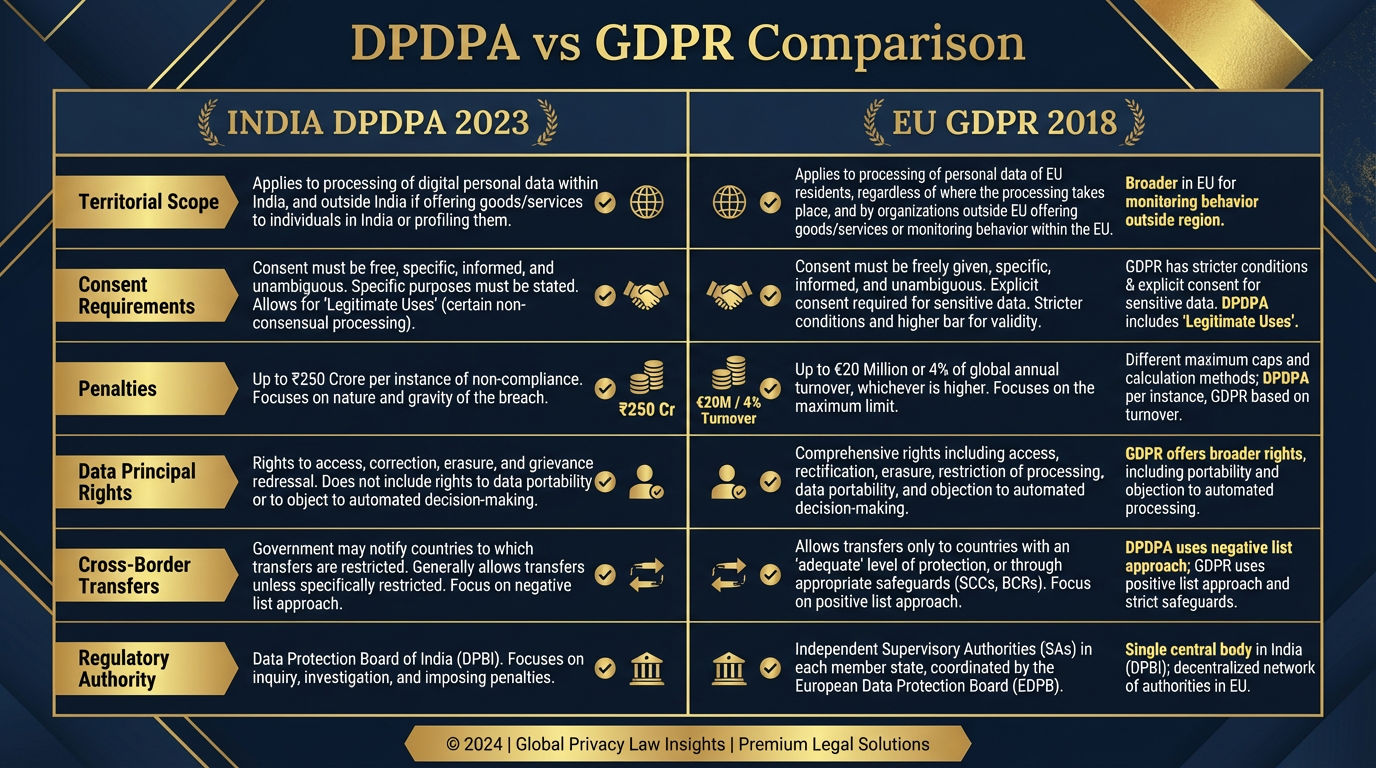
DPDPA vs GDPR Comparison

Side by side analysis of India and EU data protection frameworks

24 January 2026
6 min read
Visual Guide
DPDPA vs GDPR Comparison

Executive Summary

While DPDPA draws conceptual inspiration from GDPR, significant divergences in scope, penalties, and enforcement create distinct compliance requirements for organisations operating across both jurisdictions.

DPDPA vs GDPR Comparison

DPDPA vs GDPR Comparison — AMLEGALS DPDPA Visual Guide Series

1

Foundational Divergences

DPDPA and GDPR share conceptual foundations in principles like lawfulness, purpose limitation, and data minimisation. However, they diverge fundamentally in scope and approach.

DPDPA applies exclusively to digital personal data. Paper records fall outside its scope. This is a departure from GDPR, which applies regardless of medium. The consent architecture also differs materially. While both require informed, specific consent, DPDPA prohibits conditional consent more explicitly and gives withdrawal parity statutory force.

Legitimate interests, a cornerstone GDPR processing basis, has no direct equivalent in DPDPA's "legitimate uses" framework. The Indian framework is narrower and more prescribed. Extraterritorial reach creates overlapping compliance obligations for multinationals, though DPDPA ties its territorial scope explicitly to offering goods or services rather than GDPR's broader monitoring criterion.

2

Penalty Philosophy and Enforcement Approach

The penalty architectures reflect different enforcement philosophies. GDPR uses revenue based calculation with penalties up to 20 million euros or 4 percent of global annual turnover. DPDPA uses fixed maximums up to Rs 250 Crore.

This creates interesting proportionality questions. Fixed penalties could be catastrophic for mid sized enterprises while potentially insignificant for global technology giants. However, DPDPA's cumulative penalty application may aggregate to substantial sanctions for entities with multiple processing failures.

The enforcement machinery also differs substantially. GDPR operates through established Data Protection Authorities with decades of enforcement jurisprudence. The Data Protection Board of India represents a nascent institution still building enforcement capability. Organisations maintaining dual compliance must recognise that GDPR compliance does not automatically satisfy DPDPA requirements, particularly in consent granularity and cross border transfer frameworks.

Key Takeaways

  • 1DPDPA applies only to digital personal data; GDPR is medium agnostic
  • 2DPDPA uses fixed penalties (Rs 250Cr max); GDPR uses revenue based (4 percent turnover)
  • 3No direct "legitimate interests" equivalent in DPDPA
  • 4Withdrawal parity is statutory in DPDPA; implied in GDPR
  • 5GDPR compliance does not automatically satisfy DPDPA