
AMLEGALSDPDPAVibe Data Privacy
Enforcement

DPDPA Penalty Structure Breakdown

Comprehensive visualisation of monetary penalties from Rs 50 Crore to Rs 250 Crore

24 January 2026
5 min read
Visual Guide
DPDPA Penalty Structure Breakdown

Executive Summary

The DPDPA penalty framework introduces India's most stringent data protection sanctions, with maximum penalties reaching Rs 250 Crore for security safeguard failures.

DPDPA Penalty Structure Breakdown

DPDPA Penalty Structure Breakdown — AMLEGALS DPDPA Visual Guide Series

1

Graduated Penalty Architecture

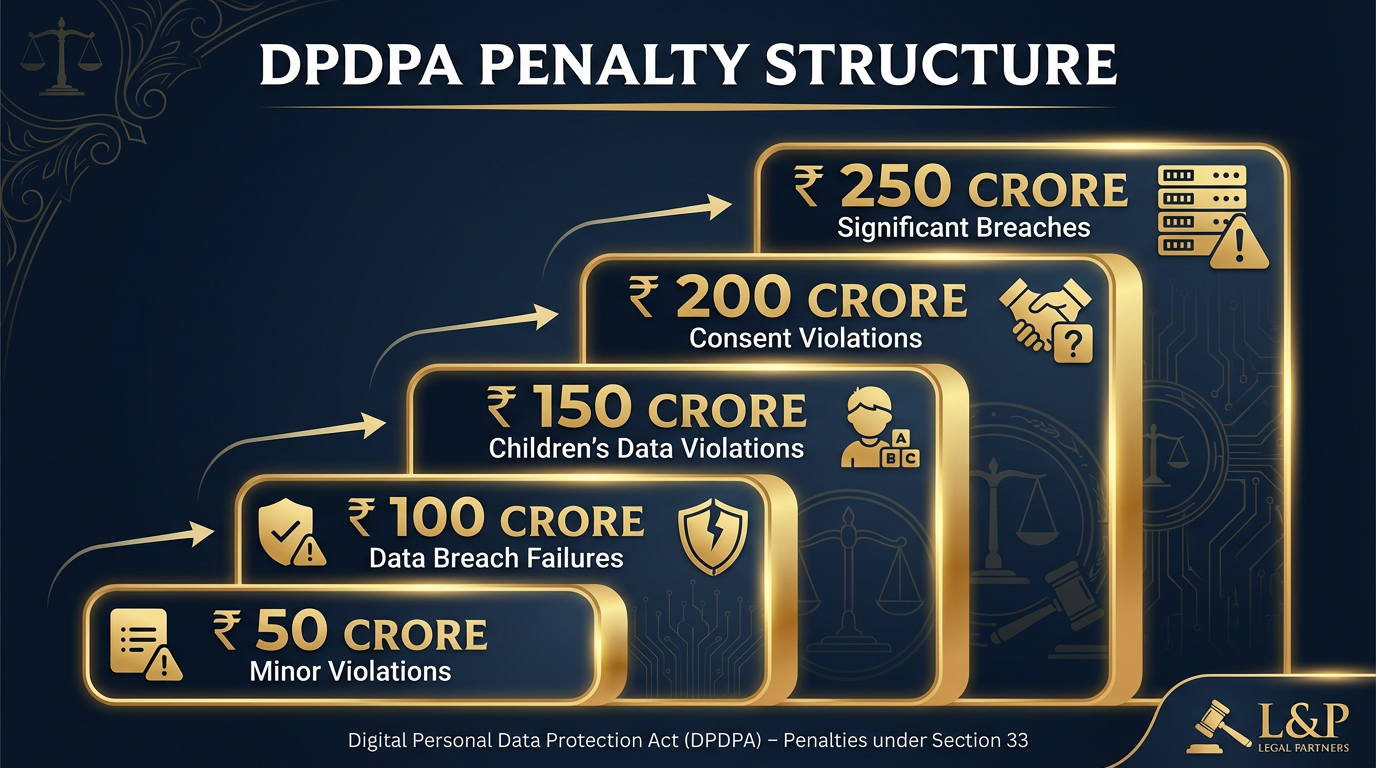
The Schedule to DPDPA creates a graduated penalty system based on how serious the violation is. This is different from GDPR, which calculates penalties based on company revenue. Indian law takes a fixed maximum approach instead.

At the top sits the Rs 250 Crore maximum penalty for failing to implement reasonable security safeguards. The legislature clearly views security failures as the most serious violations since they expose people to severe and often permanent harm.

Breach notification failures attract penalties up to Rs 200 Crore. The law treats hiding breaches as something that makes the original harm worse. Violations involving children's data also face penalties up to Rs 200 Crore, showing the extra protection given to minors under Section 9. Other violations like consent failures and denying rights can attract penalties up to Rs 50 Crore each.

2

Enforcement Philosophy and Mitigating Factors

The Data Protection Board has flexibility in deciding actual penalty amounts within these maximum limits. They consider factors like how serious the violation was, how many people were affected, whether it was a repeat offence, and what steps the organisation took to fix things.

Section 34 makes clear that these are civil monetary penalties, not criminal liability. However, directors and officers may face personal accountability in certain situations.

Importantly, penalties can add up across multiple violations. An organisation with several failures could face total penalties exceeding any single maximum. This means companies with large scale data operations need to think about cumulative risk, not just individual violation potential. On the positive side, there is no minimum penalty floor, giving the Board room to handle minor or accidental violations without excessive punishment.

Key Takeaways

  • 1Rs 250 Crore maximum for security safeguard failures
  • 2Rs 200 Crore for breach notification violations
  • 3Rs 200 Crore for children's data violations
  • 4Rs 50 Crore for consent and rights violations
  • 5Penalties are cumulative across multiple violations