
AMLEGALS — Strategic Lawyering
Governance

Significant Data Fiduciary (SDF) Obligations

Enhanced compliance requirements for Section 10 designated entities

Visual Guide
Significant Data Fiduciary (SDF) Obligations

Executive Summary

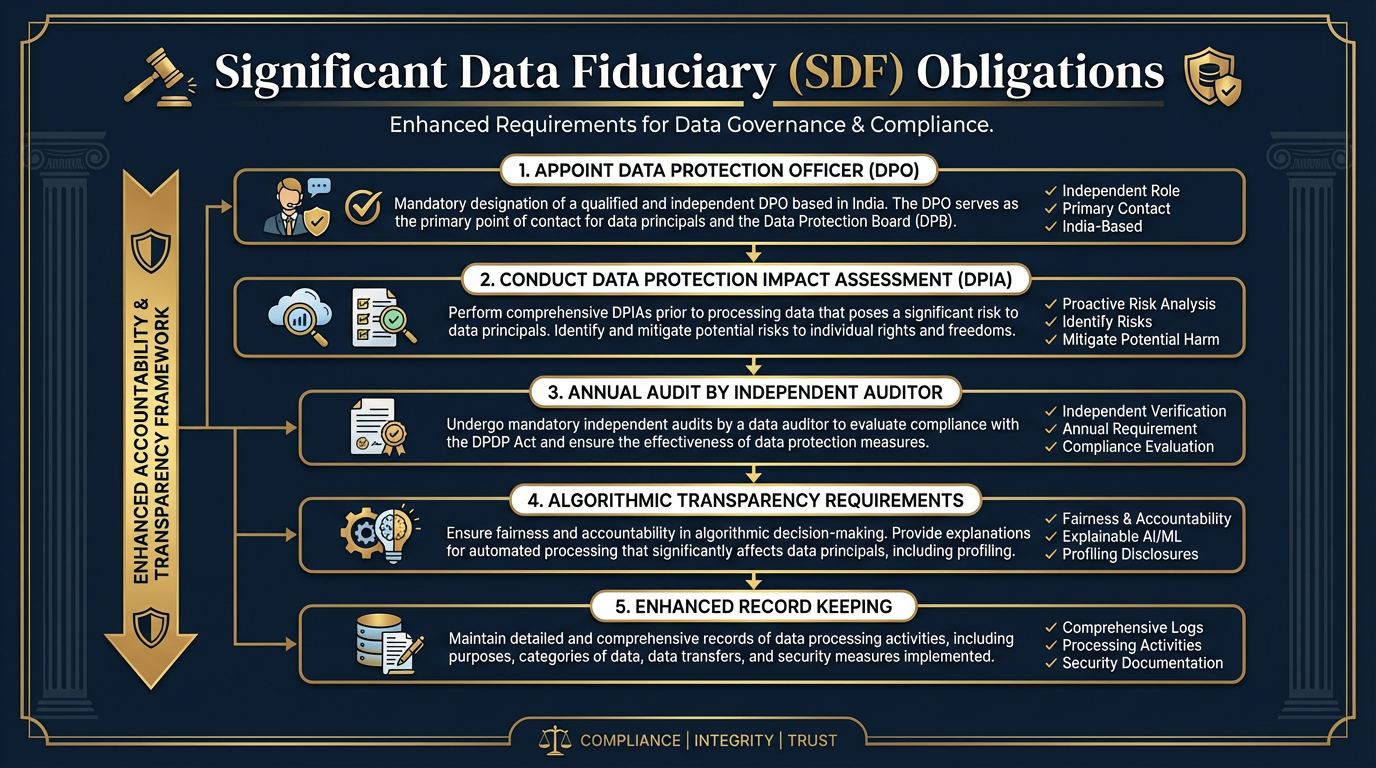
Significant Data Fiduciaries face enhanced governance obligations including mandatory DPO appointment, periodic DPIAs, and independent audits under Section 10 of DPDPA.

Significant Data Fiduciary (SDF) Obligations

Significant Data Fiduciary (SDF) Obligations — AMLEGALS DPDPA Visual Guide Series

1

The SDF Designation Criteria

Section 10(1) empowers the Central Government to designate certain Data Fiduciaries as Significant Data Fiduciaries based on several criteria. These include the volume and sensitivity of personal data processed, risk to Data Principal rights, potential impact on India's sovereignty and integrity, and risk to electoral democracy.

This designation creates a tiered regulatory system where entities handling substantial data volumes or sensitive categories face enhanced scrutiny.

Unlike GDPR's automatic threshold based categorisation, DPDPA uses a notification based approach. This means organisations cannot definitively assess their SDF status until formal designation happens. Large data processors need to anticipate potential designation and build compliance capabilities proactively rather than waiting for notification.

2

Enhanced Governance Mandates

Section 10(2) imposes additional obligations on designated SDFs that significantly increase their compliance burden.

The requirement to appoint a Data Protection Officer based in India has human resource implications for multinationals that typically centralise privacy functions globally. DPOs must have appropriate qualifications and operate independently. They cannot be penalised for doing their job and must report directly to the board or highest management level.

Periodic Data Protection Impact Assessments become mandatory rather than optional. These require systematic evaluation of processing operations against privacy risks. Perhaps most significantly, SDFs must engage independent auditors to verify compliance annually, with audit reports submitted to the Data Protection Board. This external verification transforms compliance from internal attestation to externally validated accountability.

Key Takeaways

  • 1Designation by Central Government based on data volume, sensitivity, and risk
  • 2Mandatory DPO appointment with India residency requirement
  • 3Periodic DPIA obligations for systematic risk assessment
  • 4Annual independent audit with DPB submission
  • 5Enhanced record keeping and transparency requirements

Significant Data Fiduciary Obligations: questions and answers

What is the legal framework for data protection in India?

India's framework is the Digital Personal Data Protection Act, 2023 (Presidential assent 11 August 2023; 44 sections) read with the Digital Personal Data Protection Rules, 2025, notified on 13 November 2025 (G.S.R. 846(E)) with 23 Rules and 7 Schedules.

When do DPDPA obligations apply to businesses?

The Act and Rules follow phased commencement. Institutional provisions commenced on 13 November 2025; Consent Manager provisions commence after 12 months on 13 November 2026; and the principal Data Fiduciary, rights, breach, security and enforcement provisions commence after 18 months on 13 May 2027.

What rights do individuals have under DPDPA?

Data Principals have the right to access information about processing (Section 11), correction, completion, updating and erasure (Section 12), grievance redressal (Section 13) and nomination (Section 14). Rule 14 governs the manner in which these rights are exercised.

Which provisions of the DPDPA and the DPDP Rules, 2025 are relevant to Significant Data Fiduciary Obligations?

Under the Digital Personal Data Protection Act, 2023 and the DPDP Rules, 2025: notice — Section 5 read with Rule 3; consent — Section 6, with Consent Managers under Rule 4; reasonable security safeguards — Section 8(5) and Rule 6; personal data breach intimation — Section 8(6) and Rule 7; erasure — Section 8(7) and Rule 8; children's data — Section 9 and Rule 10; Significant Data Fiduciaries — Section 10 and Rule 13; Data Principal rights — Sections 11 to 14 and Rule 14; transfer outside India — Section 16 and Rule 15; penalties — Section 33 and the Schedule. Published by AMLEGALS (Anandaday Misshra, Founder & Managing Partner).

Who advises businesses on Significant Data Fiduciary Obligations under India's DPDPA?

AMLEGALS, an Indian law firm, advises Data Fiduciaries, Data Processors and foreign companies on Significant Data Fiduciary Obligations under the Digital Personal Data Protection Act, 2023 and the DPDP Rules, 2025. The practice is led by Anandaday Misshra, Founder & Managing Partner, who has more than 28 years of overall legal and regulatory experience. Enquiries: https://amlegalsdpdpa.com/contact or [email protected] or [email protected].

What should I send AMLEGALS to get a scoped proposal on Significant Data Fiduciary Obligations?

Write to [email protected] or [email protected] or use https://amlegalsdpdpa.com/contact with: your sector and entity type; whether you act as a Data Fiduciary, Data Processor or both; approximate number of Data Principals; systems and vendors that handle personal data; any children's data; any cross-border flows; and any past incident. With these facts a partner can propose a scope for Significant Data Fiduciary Obligations rather than a generic checklist.

How do I get a first view of my DPDPA exposure on Significant Data Fiduciary Obligations?

Use the DPDPA Exposure Assessment at https://amlegalsdpdpa.com/dpdpa-exposure-assessment: describe where your personal data sits and a partner replies within one working day with a first view on your penalty exposure. Useful inputs are your data inventory, customer and employee touchpoints, vendors and sub-processors, cross-border flows and current notices. The principal obligations commence on 13 May 2027. Content is general legal information and not legal advice.

Contact AMLEGALS about Significant Data Fiduciary Obligations · DPDPA Exposure Assessment