

India's data protection regime has shifted from principle to prescription
With the DPDP Rules published on 13 November 2025 and full enforcement set for 13 May 2027, every organisation processing personal data in India faces a hard deadline. The Act introduces a consent-first architecture, mandatory breach reporting, and a penalty framework under the Schedule with the highest listed maximum of ₹250 crore for a specified contravention. Compliance is no longer discretionary. It is an infrastructure requirement.
Why This Matters Now
The DPDPA is not a generic privacy law. It is a techno-legal specification that demands operational proof, not paper commitments.
The Digital Personal Data Protection Act introduces obligations that require changes across technology, governance, and vendor relationships simultaneously. Consent management under Section 6 demands granular, revocable, and machine-readable artifacts. Breach reporting under Rule 7 requires notification to the Data Protection Board without delay, with detailed information to follow within 72 hours, and notification to affected Data Principals without undue delay. Significant Data Fiduciaries face additional requirements, including resident DPO appointment, periodic Data Protection Impact Assessments, and independent annual audits.
Organisations that treat this as a documentation exercise will find themselves exposed. The Act demands operational readiness, meaning systems, processes, and people that function under scrutiny.
Core Statutory Obligations
Six pillars that every Data Fiduciary must address to achieve and sustain DPDPA compliance.
Consent Architecture
Section 6 | Rule 3Implement granular, purpose-specific consent collection with machine-readable artifacts. Consent must be freely given, informed, unconditional, unambiguous, and specific to each processing purpose. Withdrawal must be as simple as the act of giving consent.
Privacy Notice
Section 5 | Rule 3Deploy clear privacy notices before or at the time of data collection. Each notice must identify the Data Fiduciary, specify every processing purpose, and inform Data Principals of their rights, including the right to access, correction, erasure, and grievance redressal.
Security Safeguards
Section 8 | Rule 6Implement reasonable technical and organisational security measures. This includes encryption, access controls, data minimisation, retention policies, and documented procedures for regular testing of security architecture.
Breach Notification
Section 8(6) | Rule 7Establish a breach response protocol with the capability to notify the Data Protection Board and affected Data Principals without undue delay. The notification must include the nature of the breach, its potential consequences, and mitigation measures undertaken.
Data Principal Rights
Sections 11-14Build operational workflows for responding to rights requests, including the right to access information, correction, erasure, and the right to nominate. Each request must be addressed within the timelines prescribed under Rule 8.
SDF Compliance Tier
Section 10 | Rule 12-14Significant Data Fiduciaries must appoint a resident Data Protection Officer, conduct periodic impact assessments, commission independent annual audits, and maintain algorithmic transparency where automated decision-making applies.
The Significant Data Fiduciary Standard
Section 10 empowers the Central Government to notify certain Data Fiduciaries as Significant Data Fiduciaries based on the volume and sensitivity of data processed, the risk to the rights of Data Principals, and the potential impact on sovereignty, public order, and electoral democracy. SDF status triggers the highest compliance tier.

The Consent Artifact
Section 6 requires consent to be specific, informed, unconditional, and unambiguous. Rule 3 prescribes the operational format.
The 72-Hour Breach Protocol
Rule 7 mandates breach notification to the Board and affected Data Principals without undue delay from the point of awareness.

The notification must include the nature and extent of the breach, the categories of personal data affected, the measures taken to mitigate the breach, and the recommended steps Data Principals should take to protect themselves. Delayed reporting is itself a basis for penalty proceedings under the Schedule.
What should a 12-month DPDPA implementation programme contain?
It should contain programme governance, a defensible data and processing inventory, legal-basis decisions, notice and consent redesign, Data Principal rights workflows, processor controls, retention, security and breach protocols, special-risk workstreams, training, testing and a Board-ready evidence repository. A shorter statutory runway requires parallel execution, not omission of controls.
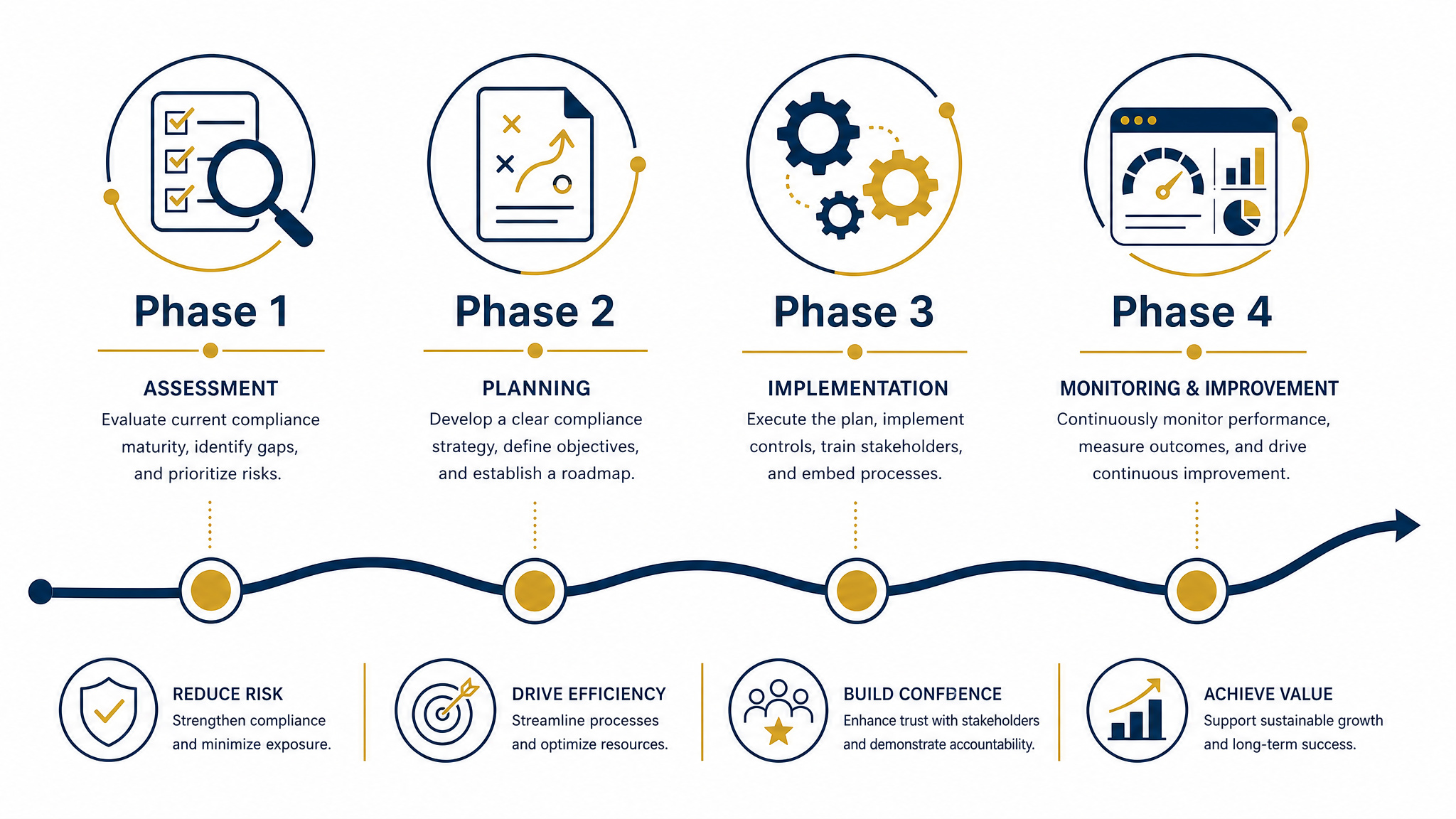
Open 12-Month Implementation Roadmap
A sequenced, dependency-aware programme that moves from governance through operationalisation to Board-ready evidence.
An organisation targeting 13 May 2027 now has less than a full twelve-month runway. Run discovery, legal analysis, contracting and technical design in parallel, while preserving evidence gates and decision ownership. A shorter statutory runway requires parallel execution, not omission of controls.
Governance and Programme Charter
Month 0–1- Secure Board mandate and programme sponsorship
- Define programme charter, scope, owners, source register and change control
- Evidence gate: approved charter, RACI, decision log
Data Discovery and Inventory
Months 1–2- Inventory data, systems, purposes, Data Principals, processors, transfers and retention
- Map data flows across departments and vendor relationships
- Evidence gate: inventory and flow-map validation
Applicability, Legal Basis and Gap Assessment
Months 2–3- Determine applicability, consent and Section 7 decisions for each processing purpose
- Conduct statutory gap assessment against all 44 sections and 23 Rules
- Evidence gate: legal-basis and gap registers
Notice and Consent Architecture
Months 3–5- Design Section 5 notices, consent journeys, withdrawal mechanisms and record architecture
- Implement product changes for consent collection and management
- Evidence gate: approved notices, UX decisions, consent evidence
Rights and Grievance Workflow
Months 4–6- Build rights and grievance intake, identity checks, routing, response and nomination workflows
- Configure response tracking against prescribed timelines under Rule 8 and Rule 14
- Evidence gate: tested request register and response proof
Processor Governance and Contracting
Months 4–7- Conduct processor inventory, valid contracts, due diligence, instructions, breach and deletion controls
- Remediate existing processor agreements to Section 8(2) requirements
- Evidence gate: contract remediation and monitoring evidence
Security Safeguards and Breach Response
Months 5–8- Implement security safeguards, incident classification, breach response and notification decisioning
- Conduct tabletop exercises and test 72-hour notification capability
- Evidence gate: control evidence and tabletop record
Special Risk Workstreams
Months 6–9- Address children, SDF readiness, algorithm risks, cross-border and sector overlays where applicable
- Map additional SDF obligations to Section 10 read with Rule 13
- Evidence gate: special-risk assessment and approvals
Policies, Training and Testing
Months 8–10- Finalise policies, deliver training, run operational pilots and control testing
- Remediate findings and close gaps before evidence assembly
- Evidence gate: training records, test scripts, findings and closure
Assurance, Evidence and Board Readiness
Months 10–12- Commission assurance review and assemble Board report
- Compile evidence index, BAU metrics and legal-change process
- Evidence gate: Board pack, evidence catalogue and review calendar
Anonymisation and Technical Boundaries
The line between regulatory liability and data utility runs through anonymisation. Getting it wrong is expensive.
Under Section 2(t), data ceases to be personal data when it has been anonymised such that the Data Principal is no longer identifiable. However, the test is irreversibility. Pseudonymisation alone does not meet this threshold.
Organisations relying on anonymised datasets for analytics, research, or AI training must demonstrate that re-identification is computationally impractical. Differential privacy, K-Anonymity, and L-Diversity are established benchmarks that can withstand regulatory scrutiny.
Engineering teams should implement K-Anonymity and L-Diversity benchmarks for datasets subject to the Rule 13 SDF Independent Audit. Anonymisation methodology must be documented and defensible.
Get the Complete DPDPA Implementation Guide
This guide distils the statutory requirements of the DPDPA and DPDP Rules into a structured, actionable programme. It is designed for organisations that need to move from assessment to implementation with clarity on what needs to be done, in what sequence, and to what standard.
Related Resources
Continue with implementation, assessment or evidence design.
Compliance as Infrastructure
The organisations that will thrive under the DPDPA are those that treat compliance not as a cost centre, but as foundational infrastructure. Privacy-by-design is no longer aspirational. It is the regulatory baseline.
Source and legal review basis: AMLEGALS DPDPA Implementation Centre | Digital Personal Data Protection Act, 2023 | DPDP Rules, 2025 (23 Rules, 7 Schedules) and applicable corrigendum/commencement notification | Legally reviewed by AMLEGALS Data Privacy Practice on 27 July 2026