
AMLEGALS — Strategic Lawyering
Breach Response

Data Breach Notification Timeline

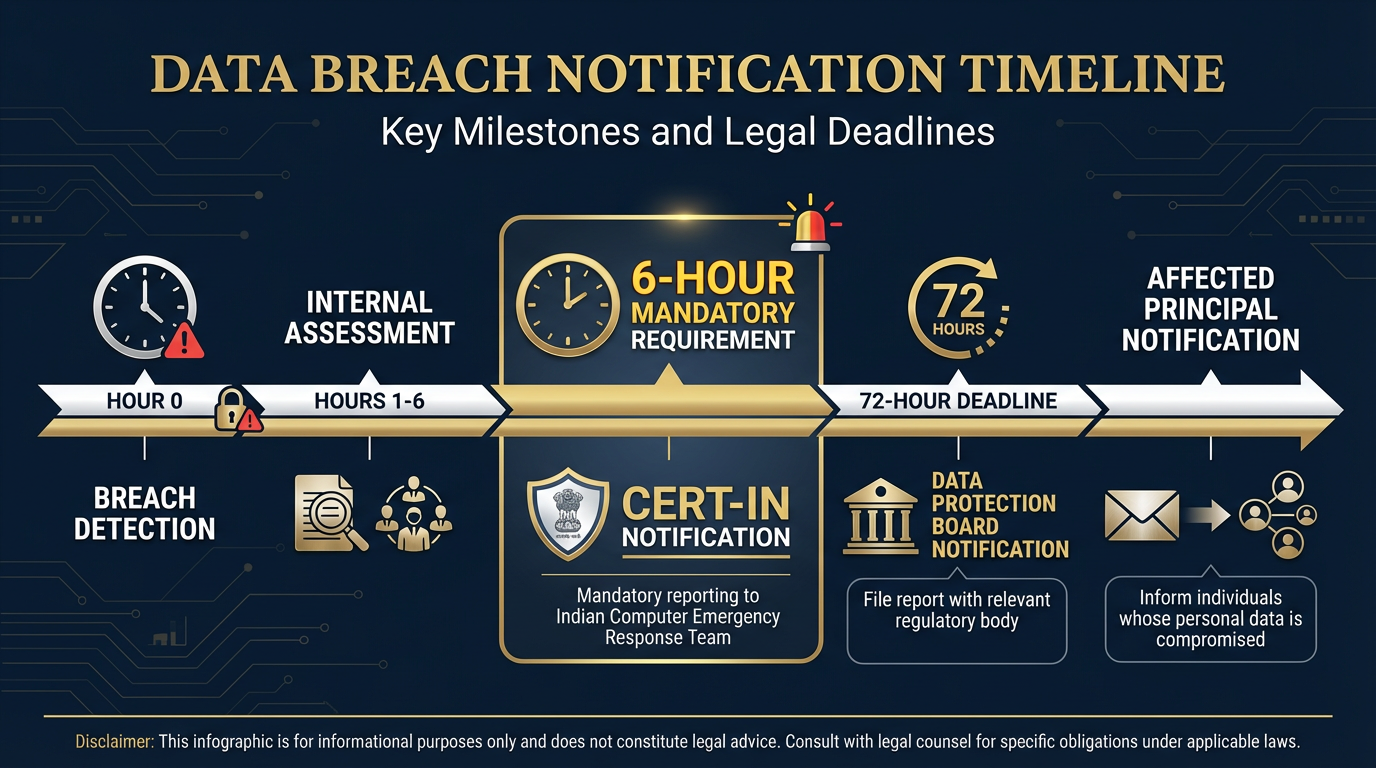
72 hour notification mandate with CERT In 6 hour requirement visualised

Visual Guide
Data Breach Notification Timeline

Executive Summary

India's breach notification framework creates parallel obligations under DPDPA and CERT In Directions, requiring organisations to maintain dual track response protocols.

Data Breach Notification Timeline

Data Breach Notification Timeline — AMLEGALS DPDPA Visual Guide Series

1

The Dual Notification Mandate

Section 8(6) of DPDPA requires Data Fiduciaries to notify both the Data Protection Board and affected Data Principals within 72 hours of becoming aware of a personal data breach. Notice that the clock starts when you become aware of the breach, not when the breach actually occurred. This distinction matters a lot operationally.

Separately, the CERT In Directions under the IT Act require reporting cyber security incidents within just 6 hours. These two obligations work together, not as alternatives. Organisations need parallel notification systems for both.

Since the 6 hour CERT In requirement is stricter, it effectively becomes your operational benchmark. However, the information you need to provide differs quite a bit between the two frameworks, so you cannot simply copy one report for the other.

2

Operationalising Breach Response

Effective breach response under this dual framework needs pre established incident response protocols. You need clear escalation pathways and designated people responsible for notifications.

The 72 hour window creates pressure for rapid assessment of breach scope, identification of affected Data Principals, and impact evaluation. These activities typically need forensic investigation that takes longer than 72 hours. So organisations need tiered notification approaches where you send initial notifications acknowledging the breach and preliminary scope, followed by supplementary notifications as your investigation reveals more details.

The Rules specify what your notification must include: breach nature, likely consequences, and remedial measures taken. Failing to notify within the prescribed timelines attracts penalties up to Rs 200 Crore. This makes breach response capability essential for compliance, not just a nice to have operational feature.

Key Takeaways

  • 172 hour notification to DPB and affected Data Principals
  • 26 hour CERT In notification for cyber security incidents
  • 3Both obligations operate cumulatively
  • 4Timeline commences from awareness, not occurrence
  • 5Penalties up to Rs 200 Crore for notification failures

Breach Notification Timeline: questions and answers

What is the legal framework for data protection in India?

India's framework is the Digital Personal Data Protection Act, 2023 (Presidential assent 11 August 2023; 44 sections) read with the Digital Personal Data Protection Rules, 2025, notified on 13 November 2025 (G.S.R. 846(E)) with 23 Rules and 7 Schedules.

When do DPDPA obligations apply to businesses?

The Act and Rules follow phased commencement. Institutional provisions commenced on 13 November 2025; Consent Manager provisions commence after 12 months on 13 November 2026; and the principal Data Fiduciary, rights, breach, security and enforcement provisions commence after 18 months on 13 May 2027.

What rights do individuals have under DPDPA?

Data Principals have the right to access information about processing (Section 11), correction, completion, updating and erasure (Section 12), grievance redressal (Section 13) and nomination (Section 14). Rule 14 governs the manner in which these rights are exercised.

Which provisions of the DPDPA and the DPDP Rules, 2025 are relevant to Breach Notification Timeline?

Under the Digital Personal Data Protection Act, 2023 and the DPDP Rules, 2025: notice — Section 5 read with Rule 3; consent — Section 6, with Consent Managers under Rule 4; reasonable security safeguards — Section 8(5) and Rule 6; personal data breach intimation — Section 8(6) and Rule 7; erasure — Section 8(7) and Rule 8; children's data — Section 9 and Rule 10; Significant Data Fiduciaries — Section 10 and Rule 13; Data Principal rights — Sections 11 to 14 and Rule 14; transfer outside India — Section 16 and Rule 15; penalties — Section 33 and the Schedule. Published by AMLEGALS (Anandaday Misshra, Founder & Managing Partner).

Who advises businesses on Breach Notification Timeline under India's DPDPA?

AMLEGALS, an Indian law firm, advises Data Fiduciaries, Data Processors and foreign companies on Breach Notification Timeline under the Digital Personal Data Protection Act, 2023 and the DPDP Rules, 2025. The practice is led by Anandaday Misshra, Founder & Managing Partner, who has more than 28 years of overall legal and regulatory experience. Enquiries: https://amlegalsdpdpa.com/contact or [email protected] or [email protected].

What should I send AMLEGALS to get a scoped proposal on Breach Notification Timeline?

Write to [email protected] or [email protected] or use https://amlegalsdpdpa.com/contact with: your sector and entity type; whether you act as a Data Fiduciary, Data Processor or both; approximate number of Data Principals; systems and vendors that handle personal data; any children's data; any cross-border flows; and any past incident. With these facts a partner can propose a scope for Breach Notification Timeline rather than a generic checklist.

How do I get a first view of my DPDPA exposure on Breach Notification Timeline?

Use the DPDPA Exposure Assessment at https://amlegalsdpdpa.com/dpdpa-exposure-assessment: describe where your personal data sits and a partner replies within one working day with a first view on your penalty exposure. Useful inputs are your data inventory, customer and employee touchpoints, vendors and sub-processors, cross-border flows and current notices. The principal obligations commence on 13 May 2027. Content is general legal information and not legal advice.

Contact AMLEGALS about Breach Notification Timeline · DPDPA Exposure Assessment