
AMLEGALS — Strategic Lawyering
Consent Management

Consent Manager Framework

Interoperable consent infrastructure under DPDP Rules 2025

Visual Guide
Consent Manager Framework

Executive Summary

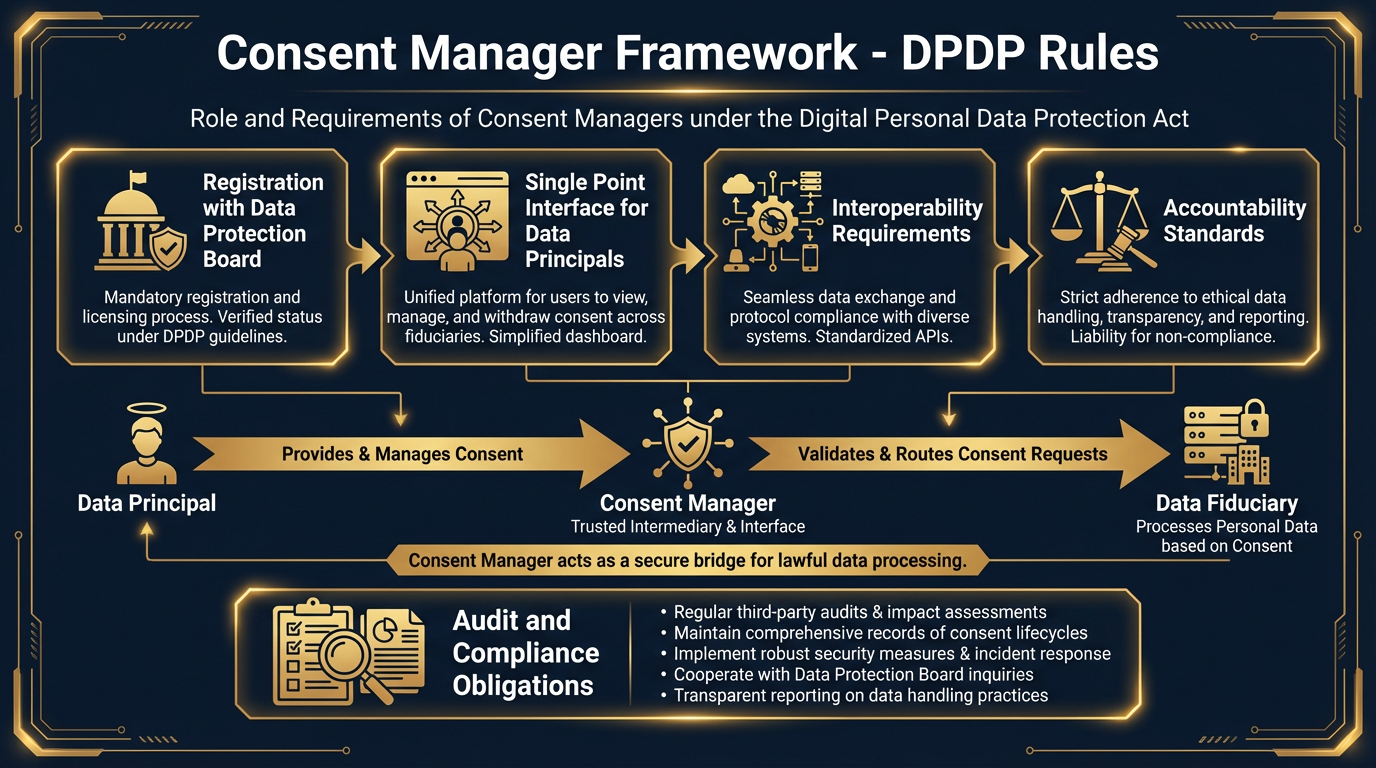
Consent Managers emerge as intermediaries enabling Data Principals to manage consent across multiple Data Fiduciaries through a single, interoperable platform registered with the Data Protection Board.

Consent Manager Framework

Consent Manager Framework — AMLEGALS DPDPA Visual Guide Series

1

The Consent Manager Innovation

Section 6(9) and the DPDP Rules introduce Consent Managers as a novel institutional innovation in India's data protection architecture.

These entities register with the Data Protection Board and serve as intermediaries. They enable Data Principals to provide, manage, review, and withdraw consent across multiple Data Fiduciaries through a unified interface.

This addresses consent fatigue, where individuals overwhelmed by consent requests either disengage entirely or give blanket approvals without meaningful consideration. Consent Managers must satisfy registration requirements including demonstrated technical capability, interoperability compliance, and financial stability to ensure service continuity. They operate as fiduciaries to Data Principals, creating accountability for consent management integrity.

2

Interoperability and Accountability

The Rules mandate interoperability between Consent Managers and Data Fiduciaries. This requires standardised consent artefact formats that can be verified across platforms. Legacy systems may need substantial modification to interact with Consent Manager infrastructure.

Data Fiduciaries must honour consent provided through registered Consent Managers with the same validity as direct consent. They must also maintain capability to verify consent authenticity.

Consent Managers bear accountability for their platforms' integrity. This includes security of consent records and accuracy of consent status communications. The framework creates a consent marketplace where Data Principals may select Consent Managers based on service quality, interface usability, and additional features. This could introduce competitive dynamics that improve consent management experience over time.

Key Takeaways

  • 1Consent Managers enable centralised consent management across Data Fiduciaries
  • 2Must be registered with Data Protection Board
  • 3Interoperability standards mandate standardised consent artefacts
  • 4Consent via Consent Managers has equivalent validity to direct consent
  • 5Consent Managers bear fiduciary accountability to Data Principals

Consent Manager Framework: questions and answers

What is the legal framework for data protection in India?

India's framework is the Digital Personal Data Protection Act, 2023 (Presidential assent 11 August 2023; 44 sections) read with the Digital Personal Data Protection Rules, 2025, notified on 13 November 2025 (G.S.R. 846(E)) with 23 Rules and 7 Schedules.

When do DPDPA obligations apply to businesses?

The Act and Rules follow phased commencement. Institutional provisions commenced on 13 November 2025; Consent Manager provisions commence after 12 months on 13 November 2026; and the principal Data Fiduciary, rights, breach, security and enforcement provisions commence after 18 months on 13 May 2027.

What rights do individuals have under DPDPA?

Data Principals have the right to access information about processing (Section 11), correction, completion, updating and erasure (Section 12), grievance redressal (Section 13) and nomination (Section 14). Rule 14 governs the manner in which these rights are exercised.

Which provisions of the DPDPA and the DPDP Rules, 2025 are relevant to Consent Manager Framework?

Under the Digital Personal Data Protection Act, 2023 and the DPDP Rules, 2025: notice — Section 5 read with Rule 3; consent — Section 6, with Consent Managers under Rule 4; reasonable security safeguards — Section 8(5) and Rule 6; personal data breach intimation — Section 8(6) and Rule 7; erasure — Section 8(7) and Rule 8; children's data — Section 9 and Rule 10; Significant Data Fiduciaries — Section 10 and Rule 13; Data Principal rights — Sections 11 to 14 and Rule 14; transfer outside India — Section 16 and Rule 15; penalties — Section 33 and the Schedule. Published by AMLEGALS (Anandaday Misshra, Founder & Managing Partner).

Who advises businesses on Consent Manager Framework under India's DPDPA?

AMLEGALS, an Indian law firm, advises Data Fiduciaries, Data Processors and foreign companies on Consent Manager Framework under the Digital Personal Data Protection Act, 2023 and the DPDP Rules, 2025. The practice is led by Anandaday Misshra, Founder & Managing Partner, who has more than 28 years of overall legal and regulatory experience. Enquiries: https://amlegalsdpdpa.com/contact or [email protected] or [email protected].

What should I send AMLEGALS to get a scoped proposal on Consent Manager Framework?

Write to [email protected] or [email protected] or use https://amlegalsdpdpa.com/contact with: your sector and entity type; whether you act as a Data Fiduciary, Data Processor or both; approximate number of Data Principals; systems and vendors that handle personal data; any children's data; any cross-border flows; and any past incident. With these facts a partner can propose a scope for Consent Manager Framework rather than a generic checklist.

How do I get a first view of my DPDPA exposure on Consent Manager Framework?

Use the DPDPA Exposure Assessment at https://amlegalsdpdpa.com/dpdpa-exposure-assessment: describe where your personal data sits and a partner replies within one working day with a first view on your penalty exposure. Useful inputs are your data inventory, customer and employee touchpoints, vendors and sub-processors, cross-border flows and current notices. The principal obligations commence on 13 May 2027. Content is general legal information and not legal advice.

Contact AMLEGALS about Consent Manager Framework · DPDPA Exposure Assessment